Philosophy and perspective
It occurred to me shortly after I logged on to create this website, while struggling to define this act of creation, that birch bark art is, to me, a “kinsugi” process. In Japanese culture, the act of repairing a broken vase, for example, with lacquer adhesive dusted with gold is considered to make the original piece even more beautiful and stronger — not despite the cracks but because of them.
By emphasizing the broken wholeness, the golden repair embraces the ‘wabi-sabi’ concept that imperfections create an elegance all its own.
While the Greek ideals of beauty revolve around perfection and the Golden Mean balance, the wabi-sabi aesthetic embraces an organic acceptance of things imperfect and not under our control. As Leonard Koren defines it: “wabi-sabi is a beauty of things imperfect, impermanent, and incomplete…and unconventional.”
In other words, the beauty of life. (Or at least my life.)
Since my first urge toward birch bark art creation was centered around trying to repair a second-hand photo frame, this definition of my process and aesthetics is spot-on. I’d looked at the veins of gold in kinsugi-saved pieces in many museums, and thought it might be a hidden map of an internal river that had carried the art on a journey.
It appears random, but I realize: birch bark is taking me on a journey.
I am creating the map.
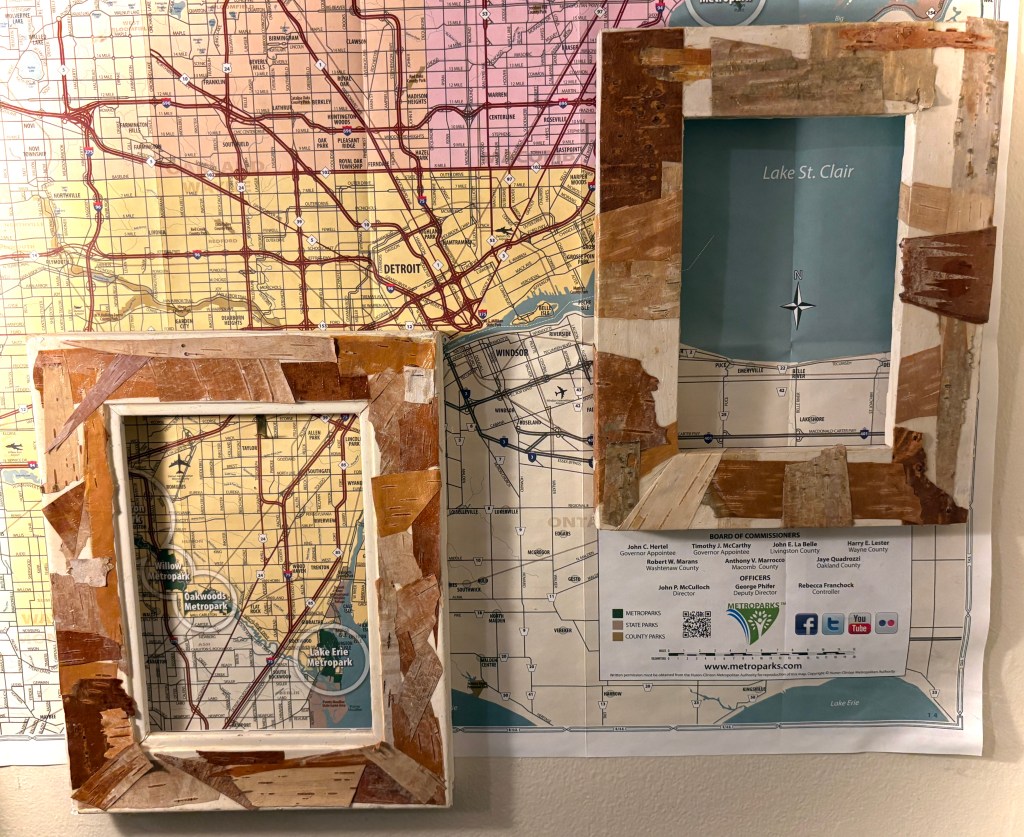
Can you guess which frame was my inaugural attempt?
 BirchBarkMosaics
Leave a comment